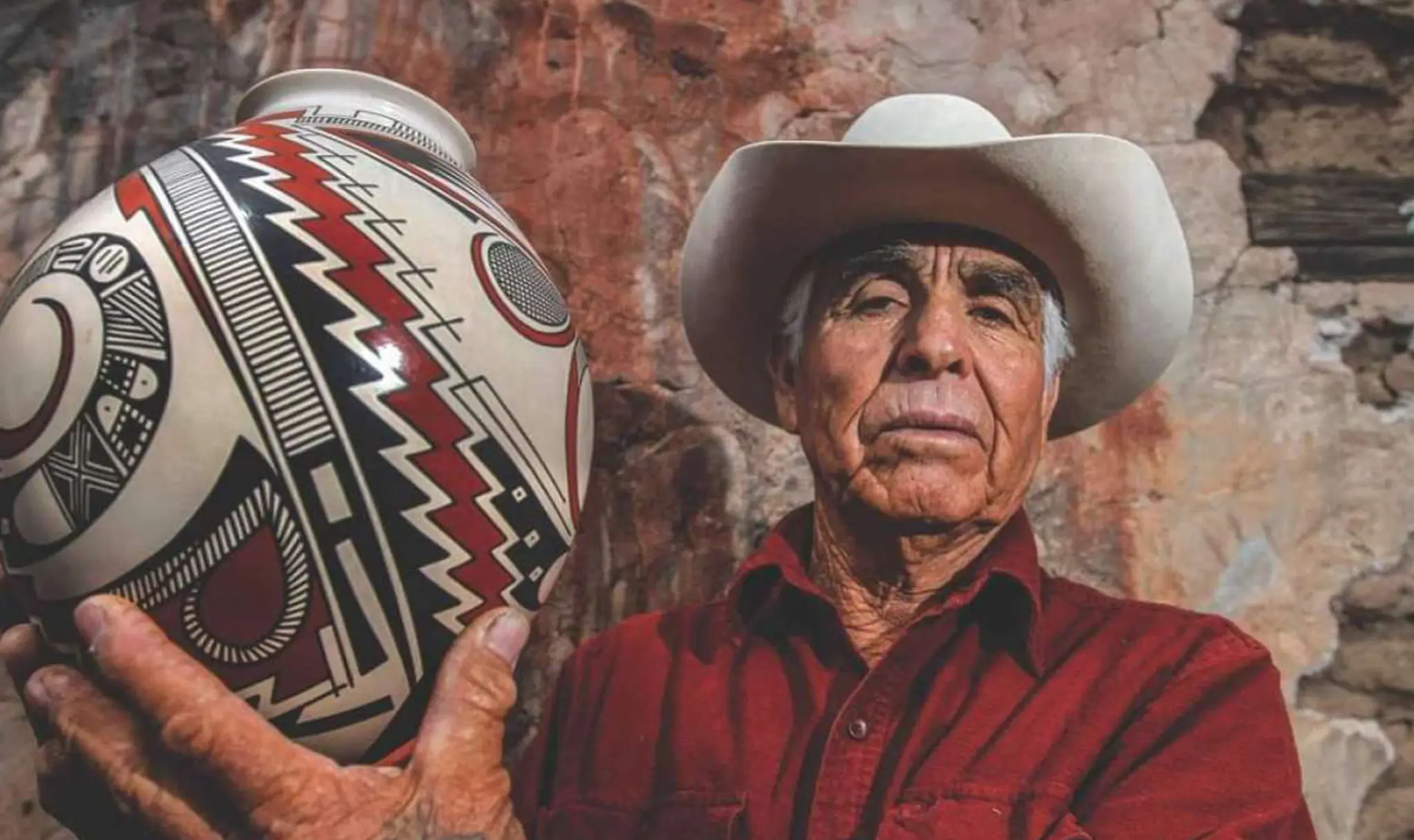
Juan Quezada Paquimé
Table of Contents
Introduction: The legacy of Juan Quezada
Mata Ortiz pottery, an artisanal treasure from Chihuahua, Mexico, is much more than just ceramic vessels. It is the story of a man, Juan Quezada, who with his ingenuity and perseverance, managed to rescue from oblivion an ancient tradition: the pottery of Paquimé. This blog invites you to discover the fascinating life of Juan Quezada and the artistic renaissance he led.
The origins of Mata Ortiz ceramics
The history of Mata Ortiz is deeply linked to Paquimé, an ancient pre-Hispanic cultural center that flourished between the 13th and 15th centuries in northern Mexico. Its inhabitants were exceptional potters, creators of vessels with complex designs and great beauty. However, after the fall of that civilization, the pottery tradition gradually disappeared, until it was almost forgotten.
Juan Quezada and the renaissance of Paquimé ceramics
In the 1970s, Juan Quezada, a humble farmer from Mata Ortiz, found fragments of ancient pottery in the vicinity of the village. Fascinated by the beauty of these vestiges, Juan Quezada set out to discover the secrets of the ancient Paquimé technique. Self-taught and with great patience, he experimented with different types of clay, pigments and firing techniques until he was able to recreate the vessels of his ancestors. With perseverance, he taught this technique to his community, which allowed them to become a society producing one of the finest ceramics in the world.
Mata Ortiz’s handcrafted ceramic workmanship
The process of creating Mata Ortiz pottery is completely handmade. From the gathering of the clay to the firing of the pieces, each stage is done by hand, using ancestral techniques passed down from generation to generation. The designs, inspired by the nature and culture of Paquimé, are painted with brushes so fine that they are even made with human hair, allowing delicate lines to be drawn with great precision. These lines are made with natural pigments extracted from minerals and plants from the region, thus reinforcing the link between the ceramics and their environment.
The art of Juan Quezada: techniques and styles
Mata Ortiz’s ceramics stand out for their constant evolution and the visual richness of their pieces. Although he preserves the traditional polished black vessels, he also incorporates works with geometric patterns and vivid colors. Juan Quezada’s creativity was key to opening up new technical and aesthetic possibilities. Today, ceramists in the region continue to explore more daring and contemporary styles, while still producing designs that honor tradition.
Predominant styles:
Mata Ortiz’s work is varied, but some characteristic styles include:
- Polished black vessels with engravings or carved drawings.
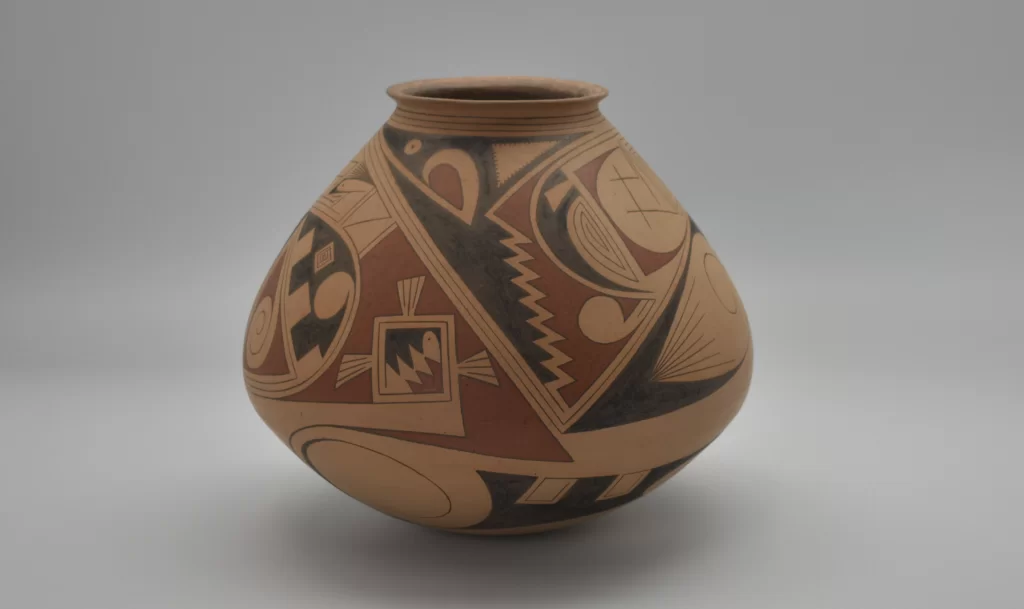
- Polychrome pieces with geometric motifs inspired by the Paquimé culture.
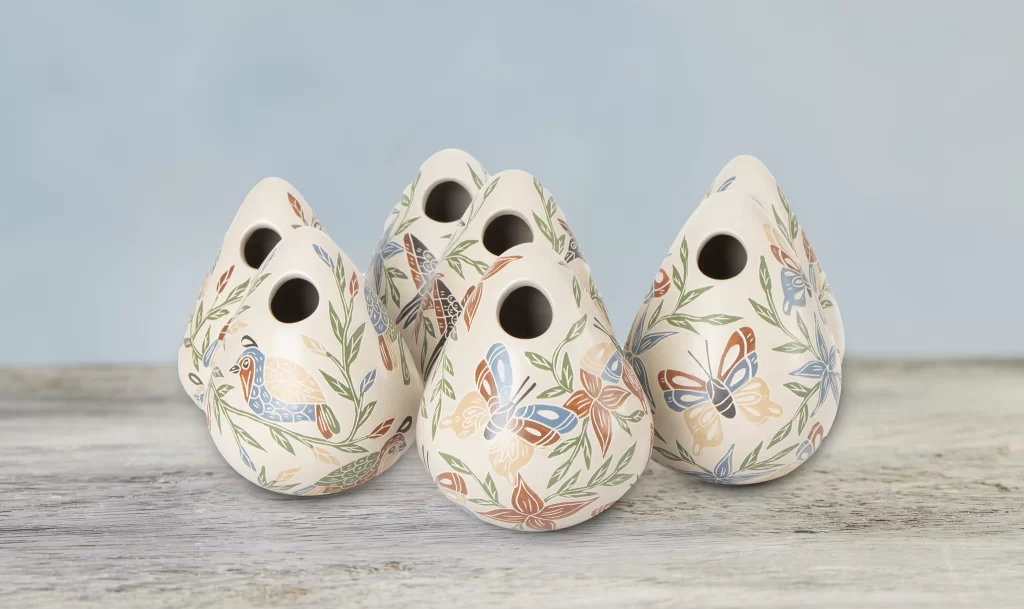
- Vessels with representations of animals and plants of the region.
- Clay sculptures depicting scenes from everyday life.
Among these styles, the use of architectural elements taken from the ancient city of Paquimé stands out. A clear example is the “T” shaped doors, present in the ruins, which have had an important influence on the designs of many pieces. This figure often appears as part of geometric patterns, either repeated or placed in the center of the design to emphasize its shape. Rather than a literal reproduction, it is a creative reinterpretation that turns ancestral architecture into a contemporary visual symbol. In this way, Mata Ortiz’s ceramic art maintains a constant dialogue with its cultural roots.
The cultural and economic impact of Mata Ortiz’s ceramics
The rebirth of ceramics, thanks to the work of Juan Quezada, has had a profound cultural and economic impact on the community of Mata Ortiz. This artistic expression has become the main source of income for many families in the town, generating employment and promoting sustainable development. In addition, Mata Ortiz pottery has contributed to strengthening the cultural identity of the region and preserving an age-old tradition. Juan Quezada’s work is now recognized worldwide.
How to buy authentic Mata Ortiz ceramics
If you wish to purchase an authentic Mata Ortiz ceramic piece, we invite you to visit our gallery DeCorazón México, located at Plaza San Jacinto 20, San Ángel, Álvaro Obregón, 01000 Mexico City, CDMX. There you will be able to buy original pieces directly, thus supporting the artisans and the community.
You can also explore our online store, where we offer domestic and international shipping so you can enjoy these unique works from anywhere. Support Mexican talent by acquiring authentic pieces with us!
Conclusion: A legacy for future generations
Juan Quezada’s story was an example of perseverance, creativity and love for culture. His legacy lives on in every vessel he created and in the artisans he inspired. Thanks to his work, Mata Ortiz’s ceramics became a symbol of Mexico’s cultural richness and a testament to the power of art to transform lives. His contribution was invaluable to Mexican craftsmanship.
References
Casa de México (n. d.). Mata Ortiz ceramics [Web entry]. Retrieved from https://www.casademexico.es/ceramica-de-la-comunidad-de-mata-ortiz-cantaro-botellon/
Al Día (Editorial Team) (December 5, 2022). Juan Quezada, artist who revived pottery of indigenous peoples of northern Mexico, dies [Online article]. Dallas News. Retrieved from https://www.dallasnews.com/espanol/al-dia/mexico/2022/12/05/muere-juan-quezada-artista-que-revivio-ceramica-de-pueblos-indigenas-del-norte-de-mexico/
Ramos, E. (n. d.). The extraordinary pottery of Mata Ortiz [Blog entry]. Expediciones Paquimé. Retrieved from http://www.expedicionespaquime.com/blog/la-extraordinaria-ceramica-de-mata-ortiz